
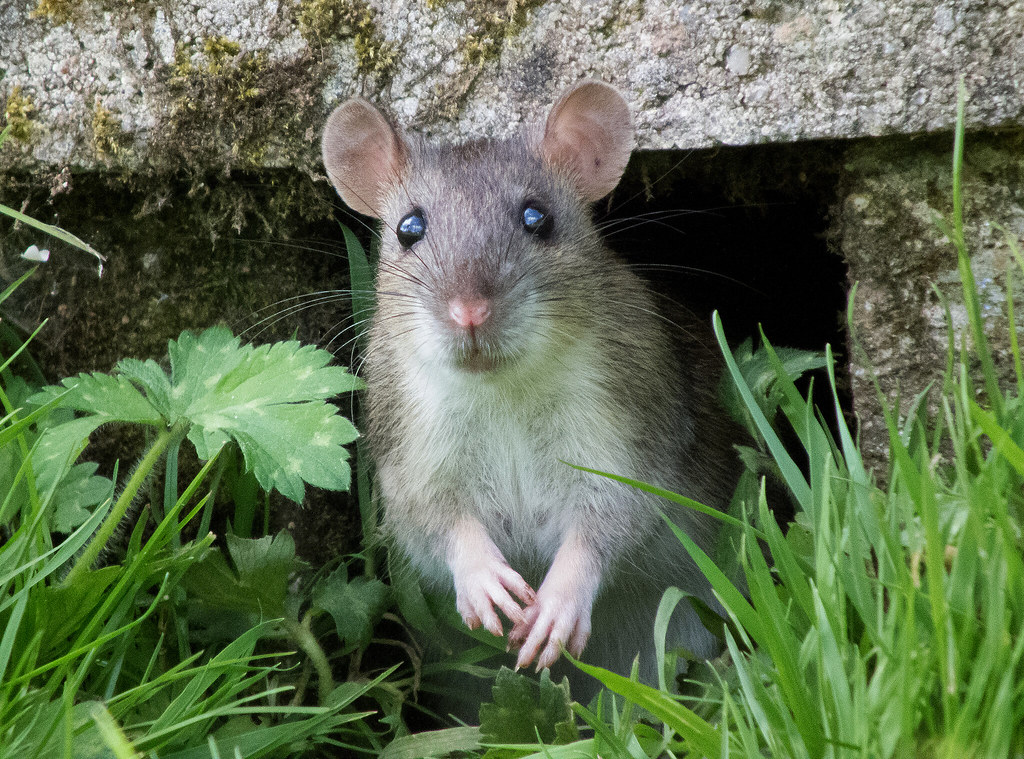
The brown rat has a number of flattering pseudonyms that include common rat, sewer rat, street rat, wharf rat and Norway or Norwegian rat. It was called a Hanover rat during the eighteenth century by those critical of the House of Hanover’s empire. Nobody understands the origin of the binomial name Rattus norvegicus (Norwegian rat). The brown rat is not from Norway. The Scandinavian rat migration was disproved. Academics erroneously shifted the source to Ireland. Naturalists in the twentieth century solved the mystery and confirmed the species originated from China.
The fur is dark gray or brown. The belly is lighter. Brown rats weigh twice as much as black ones and several times more than mice. The tail is four to ten inches. The head and body length are between six and eleven inches. Adults weigh from five to seventeen and a half ounces on average. Domestic specimens can reach up to thirty-two to thirty-five ounces. Feline sized rat sightings are fiction and the failed identification of larger rodents.
Brown rats have a strong sense of smell and sharp hearing. They are sensitive to ultrasound. Their heart beats three hundred to four hundred beats per minute with a respiratory rate near one hundred beats. Albinos have abysmal 20/1200 vision mixed with glaring light. Pigmented ones see 20/600 with no light. Both are dichromats that translate color similar to a human with red-green colorblindness. Their blue perception is unique and capable of viewing ultraviolet lights that humans and other species cannot.

Characteristics
The animal is nocturnal and an excellent swimmer and climber. They have been observed ascending slim and round metal poles to reach food. They can produce ultrasonic noises. Young rats cry out different ultrasonic vocalizations to regulate their mother’s activities. They communicate with each after two weeks of age. The frequencies are used as mating calls and as a response to imminent threats and predators.
Scientists have administered morphine to rats and discovered a distinct chirping vocalization perceived as laughter. The same response is outputted when the brown rats are tickled. The squeak is too high pitched for the naked human ear. Bat detectors and other specialized equipment can decipher the dissonance.
Brown rats are proficient diggers and capable of excavating expansive burrow networks in the wild and in captivity if there is ample substrate. The tunnels offer safety and a place to store food. The entrance is formed near an object or structure that gives the opening a roof of protection. A second entrance is created somewhere else. It could be an exit. The burrow has several levels. Females and young males never stop digging. The grandpa rats tend to avoid the manual labor. The intricate network is temperature controlled near the nest sites.

Reproduction
Breeding occurs throughout the year. A female will spawn up to five litters over twelve months. Gestation lasts for a brief twenty-one days. Seven to fourteen babies are born. Sexual maturity occurs after five weeks. A writhing and rabid population explosion is common and can increase by a factor of ten in under fifteen weeks. A single pair can multiply to fifteen thousand in one year.
Nature counters the proliferation with a maximum lifespan of three years and a ninety-five percent mortality rate. Inter-species showdowns and predators are the root of balance. Brown rats live in hierarchies within the burrow or sewer. When resources are scare the lower social ring dies off. The survivors increase their reproductive rate if too many are exterminated.
The species is a true omnivore that will consume anything. Cereals form a core part of their diet. Their favorite meals are raw carrots, cooked corn kernels and scrambled eggs. Fresh celery, peaches and beets are disliked. Foraging is a habitat specific behavior. Rats will catch fish if they are close to a hatchery. Italian brown rats have been observed diving for mollusks. Island bound Danish rats have learned to stalk and slay ducks and sparrows. Mice, chicks and small reptiles are hunted when available. City rats eat trash like royalty.

The rat king has appeared throughout history. It is more common with black rats. The phenomenon occurs when a group of rats (or mice) are bound at the tail level. The collection is formed if a knot or adhesive substance like gum or sap mixes into the tails of the rodent. The entanglement becomes fused and a king is born. It is rare to discover a living king. Sometimes human intervention can dismantle the thrashing chaos. Most times the singularity is found in decay. The original two entangled long forgotten.
Brown Rat Scientific Classification
| Domain: | Eukaryota |
| Kingdom: | Animalia |
| Phylum: | Chordata |
| Class: | Mammalia |
| Order: | Rodentia |
| Family: | Muridae |
| Genus: | Rattus |
| Species: | R. norvegicus |

2 responses to “Brown rat”
👏👏
👏